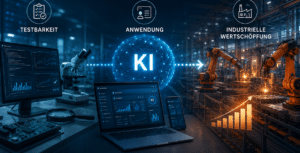
Artificial Intelligence Between Testability, Application and Industrial Value Creation
On 28 April, the sixth edition of the webinar series AI Use Cases & Future Skills took place as part of the Interreg AT-SK project Twin City Future Innovation Manufacturing Hub. The event was organized by Plattform Industrie 4.0 under the thematic focus of Work 5.0.
Speakers:
- Mateo Primorac, Founder & CEO, scopri.ai
- Sebastian Kreuter, Research Associate, Intelligent Maintenance and Product Development, Fraunhofer Austria Research GmbH
- Bernhard Nessler, Research Manager Intelligent Systems and Certification for AI, Software Competence Center Hagenberg (SCCH)
The presentations explored Artificial Intelligence from three perspectives: scientific foundations and testability, innovative AI systems in industry, and practical applications in manufacturing.
Mateo Primorac from scopri.ai demonstrated how AI in industry can evolve beyond traditional Large Language Models (LLMs). While LLMs perform exceptionally well in general-purpose tasks, they often reach their limits when dealing with highly specialized questions and industrial applications. Cognitive AI combines model intelligence with user interaction and domain-specific contextual knowledge. As a result, it continuously learns from real-world use and delivers more accurate results in complex industrial scenarios. Through practical examples, he showed how AI can analyze vast amounts of patent and scientific data within a very short time and derive valuable insights for technology scouting and market analysis. This enables companies to significantly accelerate development processes and make more informed strategic decisions. Looking ahead, he introduced a knowledge-graph-based AI system for CAD models that can assess product designs for patentability and technical risks already in the early stages of development. Future enhancements will integrate design guidelines and standards, paving the way for fully data-driven product development.
Sebastian Kreuter from Fraunhofer Austria presented several use cases of AI in industrial production. Today, companies face challenges such as increasing product complexity, growing customization demands, and a wide range of regulatory requirements. AI systems help manage this complexity by integrating and structuring data from multiple sources. One example is the automated analysis of requirement specifications, where customer requirements are extracted from documents and compared with internal standards. This allows potential errors or gaps to be identified at an early stage. Additional applications include the analysis of technical drawings and CAD data, as well as support for standards compliance checks and documentation processes.
Bernhard Nessler from SCCH addressed the fundamental question of how AI systems can be tested reliably and what “representativeness” means in this context. He explained that modern AI models are not rule-based systems but rely on statistical learning. Consequently, AI should not be evaluated based on correctness alone but on its statistical performance within a clearly defined application domain. A key challenge remains the precise definition of the testing domain, as only this enables robust and reproducible assessments of AI system performance.
The presentations clearly demonstrated that AI is not merely a technological advancement but a systemic transformation affecting research, development, and production alike.