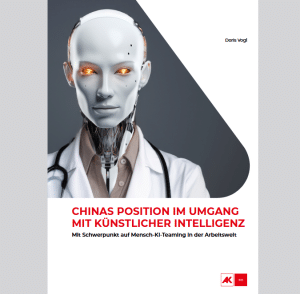
On 27 January 2026, Plattform Industrie 4.0 Austria hosted another Research Insight webinar entitled “China’s Position on Artificial Intelligence, with a Focus on Human–AI Teaming in the Workplace.”, which was organized within the Interreg AT-SK project Twin City Future Innovation Manufacturing Hub. More than 50 participants attended the webinar, during which the study commissioned by the Austrian Chamber of Labour (Arbeiterkammer) was presented by its author, Doris Vogl. In her presentation, Vogl outlined China’s current AI strategy, its implementation measures, and key industrial application areas.
In August 2025, China introduced the AI Plus Initiative, a precursor to the forthcoming 15th Five-Year Plan (2026–2030). Its objective is the comprehensive integration of artificial intelligence into key social and economic sectors. By 2027, the penetration rate of intelligent devices and AI agents in strategic sectors is expected to exceed 70 percent, rising to more than 90 percent by 2030. AI is viewed as a key driver of an “intelligent economy” and, together with big data and quantum technologies, forms part of the so-called “new quality productive forces” intended to advance social and economic development.
The national strategy is being implemented at the regional level through measures such as the establishment of AI information centres and specialised industrial clusters. These efforts are complemented by modernisation loan programmes, targeted talent development initiatives, and workforce upskilling measures.
Several key industries occupy a central role within China’s innovation ecosystem. These include humanoid robotics, the low-altitude economy based on unmanned aerial vehicles (UAVs), smart urban infrastructure, and smart manufacturing. Of particular relevance to Europe is China’s growing influence in international standardisation activities, for example in the field of care robotics.
Another major focus of the current strategy is the development of brain–computer interfaces (BCIs). A distinction is made between non-invasive systems, such as headsets and headbands, and invasive implant-based technologies. Planned initiatives include the creation of an “industrial metaverse,” BCI-controlled robots, pilot projects in high-risk sectors such as mining, nuclear energy, and hazardous goods transportation, as well as early-warning systems for monitoring workplace safety risks. At the same time, BCI technologies are increasingly being introduced in healthcare and elderly care settings.
Study download
In March 2026, China’s 15th Five-Year Plan (2026–2030) will be published, outlining the country’s strategic priorities and objectives in the fields of artificial intelligence and robotics for the coming five years. To coincide with its release, another Research Insight webinar will be organised to explore the plan’s key contents and strategic focus areas in greater detail.