In November 2025, the conference “From Silos to Ecosystems” brought together policymakers, industry leaders, and open-source advocates to discuss one of Europe’s central strategic challenges: how to turn fragmented industrial data landscapes into scalable, sovereign ecosystems that can compete globally. Across two dense days of keynotes, panels, and workshops, one message became unmistakably clear: Europe’s economic future will be decided less by isolated technological breakthroughs and more by its ability to collaborate – across companies, sectors, and borders.
Data Ecosystems as a Strategic Imperative
Throughout the conference, the political tone was unambiguous. Germany’s Federal Ministry for Economic Affairs and Energy underlined that data sovereignty and industrial AI leadership are no longer optional ambitions, but strategic necessities. While the largest AI platform providers may be based in the United States, Europe holds a decisive asset of its own: a globally unique industrial base and the data generated across its value chains. That data, speakers stressed repeatedly, has “real value”—but only if it can be shared, standardized, and used at scale.
This framing set the stage for Catena-X, which emerged throughout the conference as both proof point and blueprint. From a publicly funded research project, Catena-X has matured into a functioning data ecosystem that balances data sovereignty with cross-company collaboration. Several speakers described it as a model for other initiatives such as Factory-X, Chem-X, and beyond, demonstrating that European industry can build shared digital infrastructure without surrendering control to centralized platforms.
From Pilots to Scale
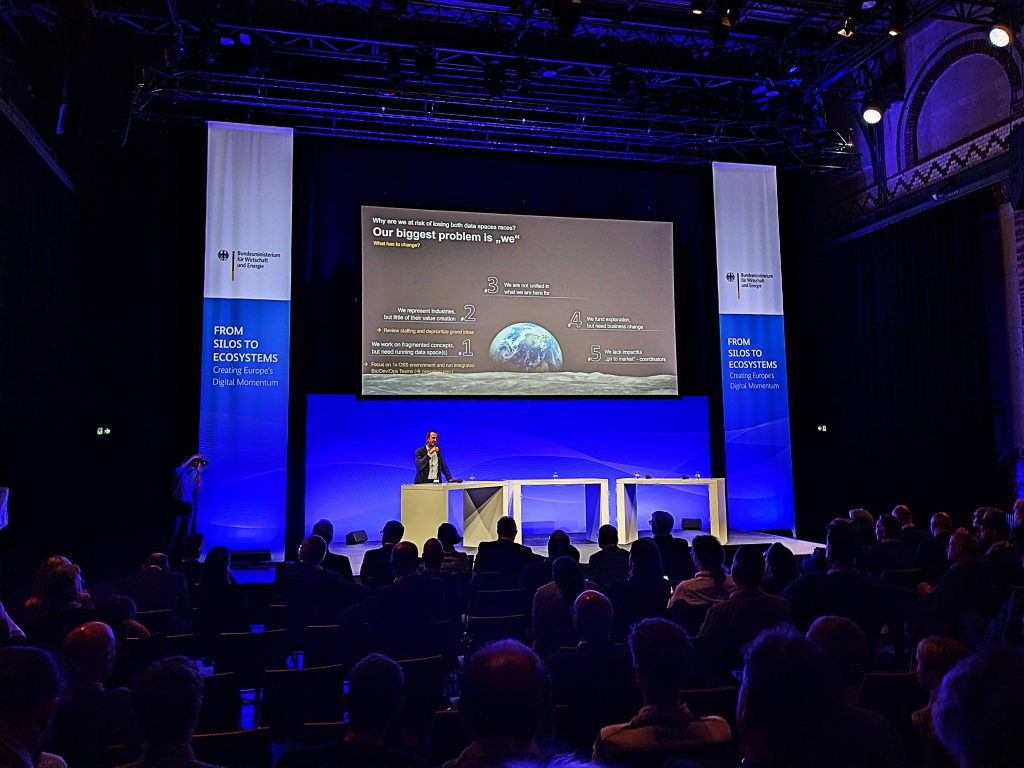
Industry representatives were frank about the remaining challenges. European companies face regulatory complexity, slow processes, and a tendency to remain stuck in pilots. What is needed now, as one executive put it, is not more concepts but “scaling up”.
Standardization was repeatedly highlighted as a critical enabler. BASF pointed to its work on a single, shared standard for calculating Product Carbon Footprints as an example of how meaningful progress can be achieved when industries align on common rules. Within Catena-X and Cofinity-X as its operating company, practical use cases, such as automated certificate management between suppliers and OEMs, are already delivering operational value by improving transparency and inventory planning across supply chains.
Importantly, speakers emphasized that ecosystems only work if participation creates tangible benefits for all parties involved, including SMEs. Simplified onboarding, usable applications, and reduced complexity were recurring demands – particularly from companies already struggling to manage hundreds of required data points across partners.
Open Source as the Backbone of Sovereignty
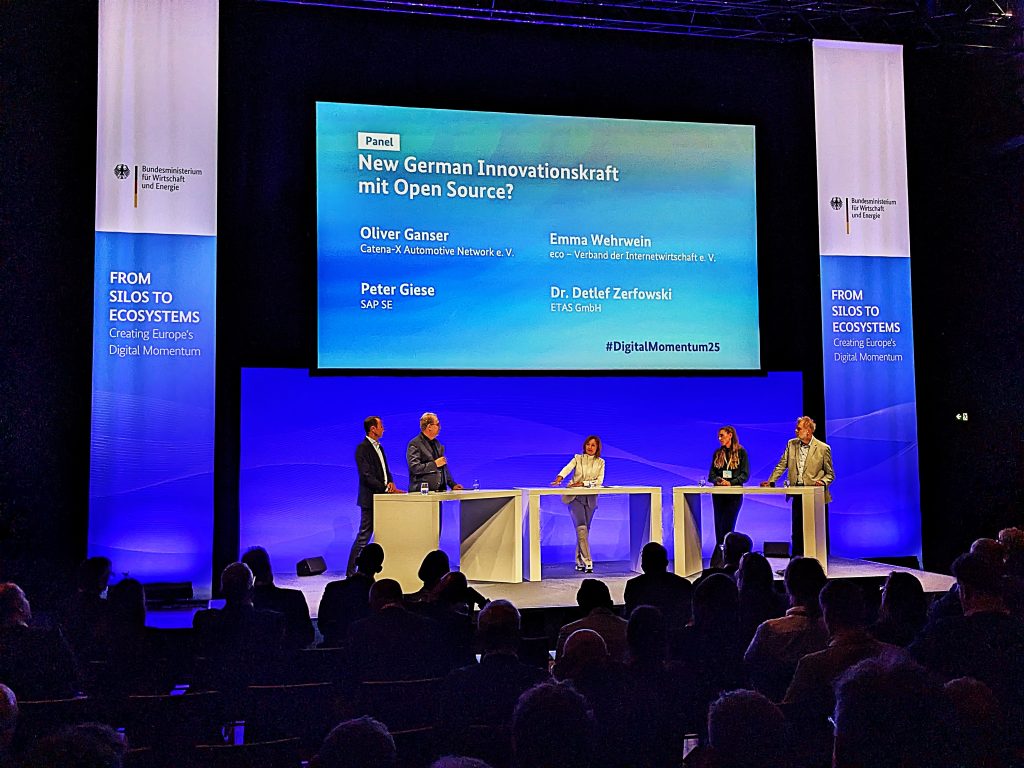
If Catena-X was a structural centerpiece of the conference, “open source” was its cultural and technical foundation. Across multiple panels, creating open source software was not merely framed as a licensing model, but as a prerequisite for sovereignty, interoperability, and long-term sustainability.
Industry voices argued that Europe still struggles to articulate the business value of open source, especially once public funding ends. Yet open source software enables exactly what industrial ecosystems require: global compatibility, continuous improvement, and freedom from vendor lock-in. Several speakers warned that without strong European open-source communities, the core digital infrastructure of future industries would inevitably be shaped elsewhere.
Concrete examples underscored the point. SAP highlighted its long-standing Open Source Program Office and its global position as a contributor, as well as its involvement in IPCEI projects and open-source foundations like NeoNephos Foundation. Automotive and industrial suppliers described how earlier attempts to build proprietary “OEM Operating Systems” had failed. Today, collaborative open-source approaches around in-vehicle software and industrial components are now gaining traction. The Eclipse S-Core project serves as an example for this development.
The message was clear: open source is not a risk to industrial competitiveness – it is the mechanism that makes shared ecosystems viable at all.
Industrial AI and the Role of IPCEI-AI
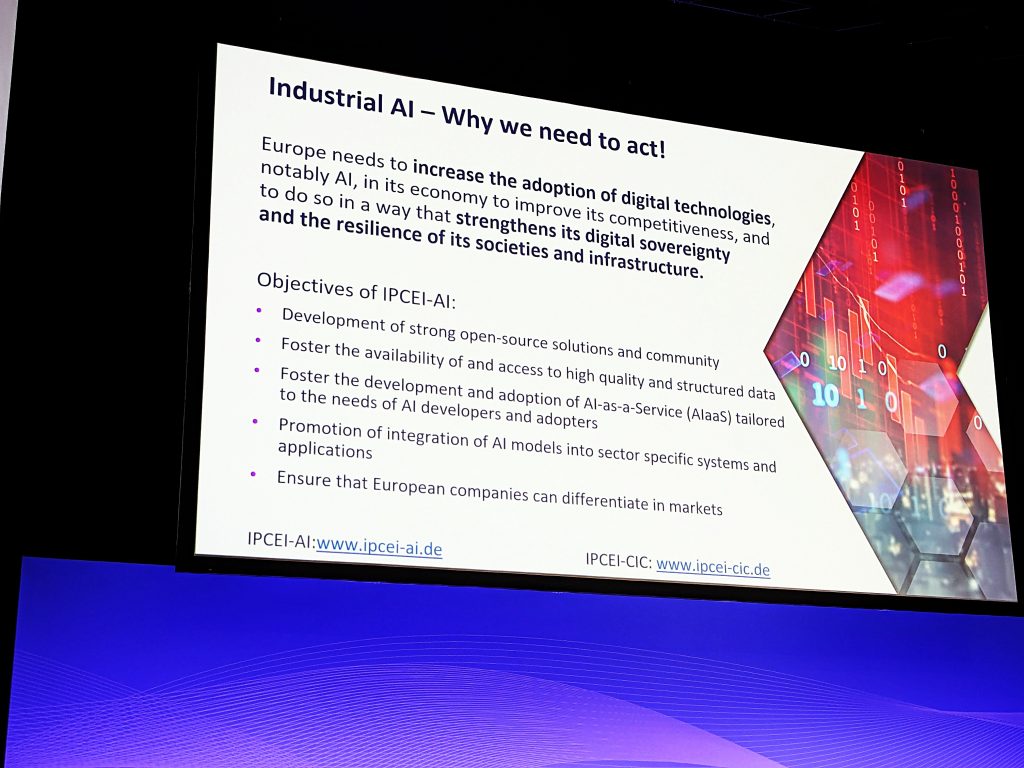
Artificial intelligence was a topic mentioned constantly at the event, increasingly seen as inseparable from data spaces. Oliver Ganser of BMW/Catena-X distinguished between two global races: the technology race for AI models, where Europe has clearly fallen behind, and the adoption race, where the outcome is still open. It is in this second race for industrial application, integration, and scale, where speakers believe Europe can still lead.
Here, the planned IPCEI-AI initiative was featured prominently. Building on experiences from IPCEI-CIS/8ra, IPCEI-AI is expected to mobilize investments at a multi-billion-euro scale. However, participants were clear that funding alone would not be enough. Without functioning data ecosystems, shared governance models, and coordination across sectors, even large budgets risk dissipating into disconnected projects. Several speakers argued that data spaces like Catena-X could provide the foundational layer for IPCEI-AI, connecting industrial data with decentralized AI capabilities, including edge and cloud infrastructures.
Proof from Industry: Digital Twins at Scale
One compelling industry example came from Bosch Rexroth, illustrating how far industrial data ecosystems have progressed in practice. The company has built an internal data ecosystem spanning product lifecycle management, semantic models, and the Asset Administration Shell (AAS). Today, Bosch reports having around 380 million digital twin instances available as standardized AAS representations that can be integrated into data spaces and AI applications.
From Silos to Ecosystems
A shared conclusion emerged from the conference: Europe does not primarily suffer from a lack of ideas or initiatives, but from fragmentation and hesitation. Moving from silos to ecosystems requires less regulatory fear, more trust in collaboration, and a stronger commitment to open standards and open source.
Catena-X showcases that a collaborative approach of European manufacturing companies is possible. The planned IPCEI-AI project represents a major opportunity to combine data space initiatives with innovative software applications. Whether those efforts succeed will depend on the ability of industrial players to scale what already works – and to do so together.

Participation at the event was possible through the SM4RTENANCE project. Within SM4RTENANCE several European manufacturing companies and research institutions are working on implementing data spaces and data space solutions. The project is co-funded by the EU under grant agreement No 101123490.