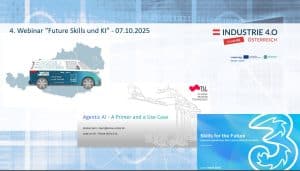
On October 7th, the 4th webinar on Future Skills & AI in the focus area Work 5.0 took place. The event was organized by Plattform Industrie 4.0 as part of the Interreg AT-SK project “Twin City Future Innovation Manufacturing Hub.”
Agentic AI: Opportunities and Challenges
Roman Kern, Chief Scientific Officer at Know Center Research GmbH and Associate Professor at TU Graz, opened the webinar with insights into Agentic AI. Modern AI technologies such as large language models (LLMs), generative AI, and visual transformers are already capable of understanding language, analyzing images, drawing simple inferences, and generating text and visuals. They offer new applications in search, document understanding, and knowledge management, boosting productivity and quality.
However, challenges remain: AI can produce hallucinations, outdated data may create knowledge gaps, and systematic biases can lead to errors or inconsistent responses.
Agentic AI refers to systems that autonomously perform tasks, make decisions, and manage processes to support humans and increase productivity. Today, most AI agents remain supportive, automating workflows rather than acting fully autonomously. A practical example is AI assisting in business travel processes, automatically checking boarding passes or receipts to improve efficiency.
While the vision of multiple agents autonomously handling complex tasks is still under research, a new Komet research module starting in 2026 will further explore Agentic AI, including interactions between AI systems and humans. Currently, humans remain indispensable, and responsible AI use is critical.
KI-Mobil: Bringing AI Directly to Companies
The second presentation by Matthias Hayek, Head of Assembly Planning and Assistive Systems at Fraunhofer Austria Research, focused on KI-Mobil. This mobile innovation platform makes AI tangible and practical, bringing demonstrators and workshops directly into companies.
KI-Mobil showcases real-world AI applications in areas such as quality control, production planning, and procurement optimization, while fostering collaborative idea development. The project also emphasizes Future Skills such as prompt engineering, human-in-the-loop processes, and agile project management for AI initiatives.
AI in Practice: Voice Systems for B2B
Finally, Daniela Rodriguez Ulloa, Enterprise Solutions Manager at Hutchison Drei Austria, presented the company’s first AI-powered B2B voice product. The project responds to the new EU AI Act, which requires AI competencies to be embedded across all business areas, from technical teams to legal and compliance.
The project focused on creating a voice system that can be independently operated and flexibly developed. Key takeaways included:
- AI impacts all teams, requiring company-wide understanding
- Compliance by design ensures data protection and transparency from the start
- Agility and continuous learning are essential for successful AI projects
The experience highlighted the importance of close collaboration between technology, business, and legal teams. Those willing to learn and take responsibility will stand out in the AI era.
We thank all three speakers for their insightful and inspiring presentations.